A report on April 4 alleged that a Nigerian national with Covid-19 had attacked a Chinese nurse who tried to stop him leaving an isolation ward at a Guangzhou hospital. The report was shared widely on social media, and local Africans CNN spoke to say a racist backlash against the African community followed.
Then on April 7, Guangzhou authorities said five Nigerians had tested positive for Covid-19.
Fearing a cluster among the African community, Guangzhou authorities upgraded the risk level of Yuexiu and Baiyun, the areas home to the city’s two African enclaves, from low to medium, state-owned Global Times reported.
The local government Tuesday reported 111 imported cases of Covid-19 in Guangzhou, with 28 patients from the UK and 18 from the US. In interviews with CNN, Americans and British nationals in Guangzhou said they had not heard reports of forced testing, home evictions and additional quarantine measures being imposed on members of their communities.
On Saturday, however, the US Consulate in Guangzhou warned African-Americans to avoid travel to the city.
“In response to an increase in Covid-19 infections, officials in the Guangzhou metropolitan area escalated scrutiny of foreign nationals,” the consulate said in a statement. “As part of this campaign, police ordered bars and restaurants not to serve clients who appear to be of African origin. Moreover, local officials launched a round of mandatory tests for Covid-19, followed by mandatory self-quarantine, for anyone with ‘African contacts,’ regardless of recent travel history or previous quarantine completion.
“African-Americans have also reported that some businesses and hotels refuse to do business with them.”
Africans on lockdown
Smith, the American expat who helped coordinate the food drop, lives in Guangzhou with her Moroccan boyfriend.
In late February, the couple went on holiday to Malaysia. She returned on March 17, and says she was was asked to self-isolate at home for 14 days. He returned on March 25, and says he went into a government quarantine facility, paying 400 yuan ($56) a night at a designated hotel, and emerged on Wednesday after testing negative twice.
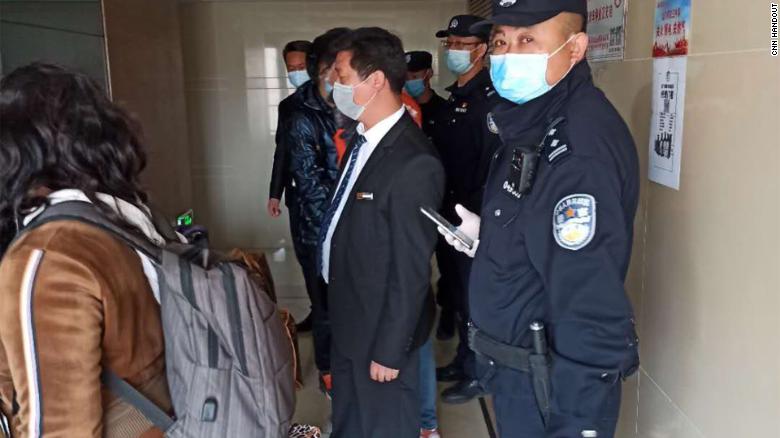
On Thursday, health authorities came to the couple’s flat and said that Smith’s partner, who did not want to be identified in this piece, would have to quarantine at home for 14 days because all Africans in the city were being put on lockdown, Smith says.
Smith says her employer, an international school in Guangzhou, was informed on Thursday that all Africans needed to go into lockdown, as it has several South African employees. CNN has spoken to several other Africans who were visited by authorities on Thursday and told they needed to quarantine at home for 14 days. They say police put alarms on their front doors, which will alert officials if they leave home.
There have been no public statements confirming or refuting the existence of an official policy about these measures.
Smith was told if she chose not to live in the apartment she shares with her African boyfriend, who has twice tested negative for the virus, she would not have to quarantine. “There’s resentment in Guangzhou that a lot of Africans are perceived to be here illegally and that they overstay,” said Smith. “There’s been a push in Guangzhou to get them out. This has been an easy excuse to push this community out.”
When the authorities came to Peter Busari’s Guangzhou apartment on Wednesday to test him, he filmed the exchange and went live on Facebook. That footage shows officials also asking to see his passport and checking his visa.
Wang Wei, a PhD candidate at the University of Hong Kong, who has been studying the African community in Guangzhou for several years, said testing Africans gave the government a chance to conduct a mass checking of passports, too.
“It threatens the undocumented Africans,” he said. “Officially, African foreigners (in Guangzhou) decrease every year but we all know that undocumented Africans still live in this circle doing business underground or through brokers. But because of the pandemic they will become exposed.”
Those caught overstaying their visas will be taken into police custody, asked to pay a 10,000 yuan ($1,421) fine and often charged for their airfare back to their home country, said Wang.
Roberto Castillo, an assistant professor at Lingnan University, who has researched the African community in Guangzhou for nearly a decade, says the Yuexiu district where the Nigerian Covid-19 cases were found has “historically been a place where the African community is in more tension with the authorities,” and was a troubled site during the Ebola crisis of 2014, when Africans of all nationalities were stopped and checked, regardless of whether they were from affected nations.
In 2009, a riot among Africans was sparked in Yuexiu after a Nigerian man who was rumored to be undocumented was injured jumping from a building to avoid a passport check.
Africans in Guangzhou have been encouraged to leave the city in recent years through a series of immigration policies, economic developments and heightened policing.
Meanwhile, on Thursday reports emerged from Africans in China that the crackdown on Africans is wider than Guangzhou. One Ghanaian family in Beijing, with no recent travel history or contact with Covid-19, reported that police came to their apartment in the early hours of Thursday morning and ordered them to leave. The Ghanaian embassy in Beijing confirmed that two Ghanaian nationals were currently seeking refuge there, but declined to comment. Africans in Chengdu and Fujian province also told CNN they had been visited by community officials.
China-Africa relations
“Why are we being discriminated against like this? Are there no Chinese in Africa?” one African is heard asking a Chinese policemen on the street in Guangzhou, in a video shot on Thursday evening, as many faced another night sleeping rough on the streets of the city.
It is a question that speaks to the implications a crackdown on Africans in China could have on Beijing’s bilateral relations with governments on the continent, which they have courted with investments for decades and where anti-Chinese sentiment is already rumbling. About 1 million Chinese are estimated to be living in Africa.
On Twitter, one user noted that Kenya allowed a plane of Chinese nationals to land in Nairobi, at the height of China’s crisis, but when the virus reached Africa the same compassion had not been shown in Guangzhou.
Adapted from CNN